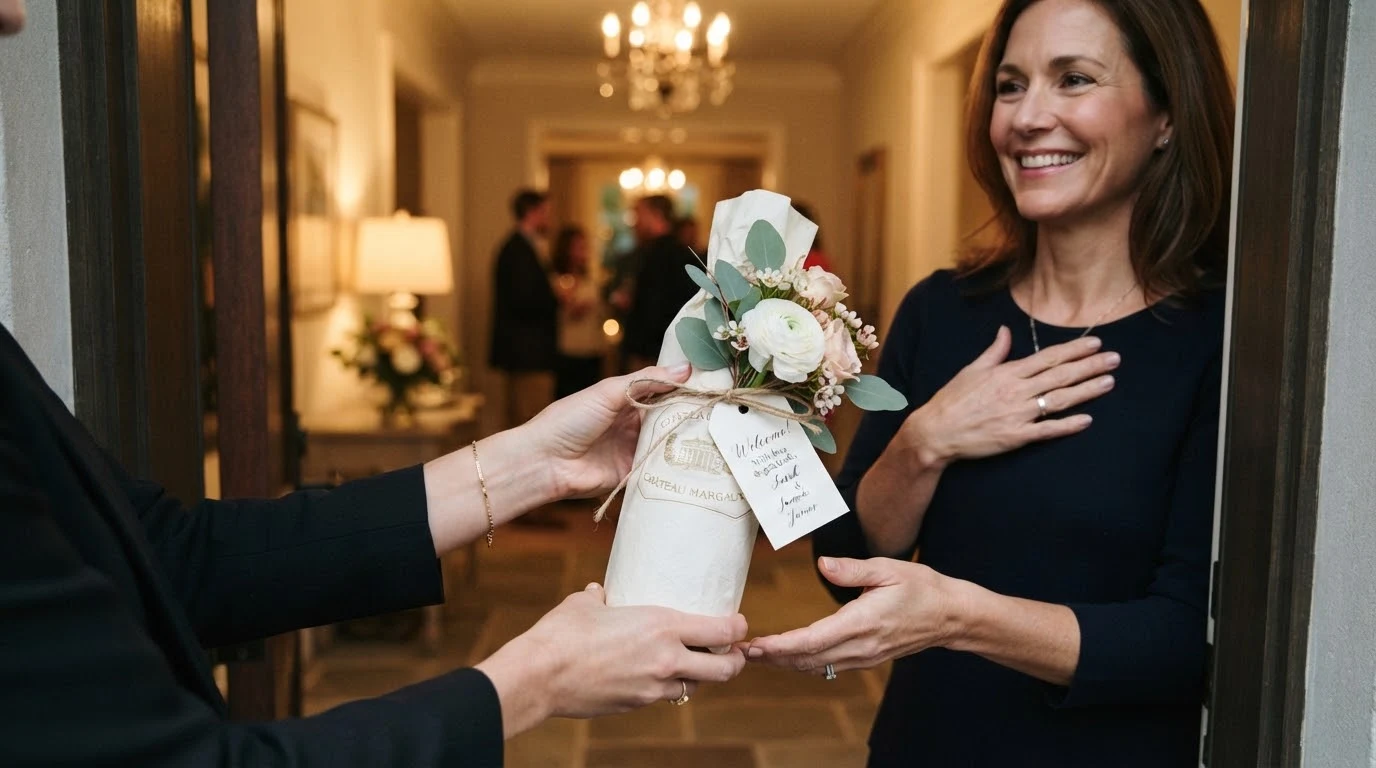
You're on the front step, about to ring the bell, when you notice your hands are empty. Maybe the invitation said not to bring anything. Maybe you came straight from work and the plan to grab flowers quietly fell apart somewhere between the office and the highway. Either way, a small, uncomfortable question shows up right before the door opens: is this rude?
The short answer is that it depends on the occasion, though not as much as people hope. For a dinner or small gathering in someone's home, a modest host gift is the expected courtesy in most of North America, and arriving with nothing can read as a little careless even if nobody mentions it. It is not, however, a serious offence. Plenty of gatherings call for nothing at all, and forgetting is one of the easiest etiquette slips to put right.
Below, we'll look at why the custom exists, which events really call for a gift, how expectations shift between cultures, and what to bring when you'd like to do better than a last-minute bottle of wine.
Why we bring something in the first place
A host gift is a small object doing a fairly big job. Before you arrived, someone cleaned, shopped, cooked, set a table and gave up an evening so that you could enjoy one. The gift at the door is how a guest says, without making a speech about it, that the effort was noticed.
It helps to think of it as an acknowledgement rather than a payment. Hospitality has long been understood as something that runs both ways: the host opens their home, and the guest arrives with some contribution to the occasion, however small. You'll find versions of that exchange in hospitality traditions all over the world, which is part of why the habit feels so instinctive to many people even when they can't say where it came from.
That framing also explains why price matters less than people assume. A host gift isn't supposed to cover the cost of the meal, and an extravagant one can make a host uncomfortable, as if the dinner has quietly become a transaction. For most dinners, the sensible ceiling is about what you'd spend on a decent bottle of wine, and some of the gifts hosts appreciate most cost far less. What people tend to remember is whether a gift felt chosen for them.

When arriving empty-handed matters, and when it doesn't
Most of the answer lives in the type of event. The smaller and more personal the gathering, the more a host gift is expected. The larger and looser it gets, the less anyone is keeping track.
Occasions where you should bring something
A dinner party is the clearest case. When a host has cooked for six or eight people, every guest is visible, and arriving with nothing stands out more than it would at a crowded party. The same goes for a first visit to someone's home, whether that's a new friend's apartment or your partner's parents' house. First impressions are partly made at the door, and a small gift is an easy way to start things off on a warm note.
Overnight and weekend stays raise the bar a little. You're using their guest room, their towels and their coffee, so something a bit more substantial is fair. Many guests handle this by bringing a gift and also taking their hosts out for a meal, or by cooking dinner one night of the stay.
Housewarmings are a special case, because the gift is part of the point of the event. People are setting up a new place and usually need things. If the hosts have created a housewarming registry, that's the easiest way to give them something they'll actually use instead of a fourth set of coasters.
Occasions where it's genuinely optional
Large, casual gatherings sit at the other end. At a backyard barbecue for forty people, an open house or a drop-in holiday party, the host is unlikely to notice who arrived with what. Bringing a six-pack or a dessert to share is a friendly move, but no one will think less of you for skipping it.
Potlucks answer the question for you. The dish you bring is your contribution, and a separate host gift isn't expected. The same logic covers a casual dinner where you've been asked to bring the salad or the drinks.
Then there's family and very close friends. Nobody brings a hostess gift to their sister's place every Sunday, and doing so would feel strangely formal. In those relationships, generosity shows up in other ways: hosting in return, helping clean up, remembering birthdays.
When the host says not to bring anything
This is where people get stuck. Most of the time, "don't bring anything" means "I have the food and drinks covered, please don't feel obliged to contribute to the menu." It usually isn't a ban on a small gesture. Something modest that asks nothing of the host, such as chocolates, a candle or a jar of good jam, is almost always welcome.
Sometimes, though, people mean it more literally. Some hosts are decluttering, some find gifts awkward, and some have said it plainly enough that ignoring them would be its own kind of rudeness. If you can't tell which kind of request you're dealing with, it's perfectly polite to ask.

How the rules change from culture to culture
In many households, arriving empty-handed is a bigger deal than it is at a typical North American dinner, and the details of what you bring carry more meaning too. If you're visiting a family whose traditions differ from yours, a little homework goes a long way.
In Japan, bringing a small gift when you visit someone's home is customary, and it's often something edible, like sweets or a specialty from your own region. Presentation counts. A neatly wrapped box offered with a bit of modesty will land better than an expensive item handed over casually.
In Chinese tradition, some gifts carry unlucky associations. Clocks are the best-known example, because the phrase for giving a clock sounds like the phrase for attending a funeral, and the number four is avoided for similar reasons. Don't be surprised if your gift is politely declined once or twice before it's accepted, or set aside to be opened later. Neither is a rejection.
In Russia and much of Eastern Europe, showing up to someone's home with nothing in hand is generally frowned upon. Flowers are a common choice, but they should come in odd numbers, since even-numbered bouquets are associated with funerals. Several Western European countries have their own flower codes as well, with chrysanthemums tied to mourning in places like France and Italy.
Finally, think about what your hosts actually consume. Wine is the reflexive North American host gift, but it's the wrong choice for many observant Muslim families and for anyone who doesn't drink. Good sweets, dates, fruit or a plant are safe, generous alternatives in almost any home.
What to bring (besides another bottle of wine)
Wine became the default host gift for good reasons. It's easy to find, it travels well and most people are happy to receive it. It does come with one etiquette wrinkle worth knowing: your host is under no obligation to open it that night. They've likely planned what to pour with the meal, so hand it over with something like "this is for you to enjoy another time" and let them off the hook.
Flowers have a different problem. A bouquet handed over at the door means your host has to stop greeting guests, hunt for a vase, trim stems and find a spot for it, all while the oven timer is going off. If you love bringing flowers, bring them already arranged in something, or choose a potted plant or herb that needs no immediate attention.
Beyond those two classics, the best host gifts tend to share a quality: they make the host's life a little nicer without creating work. A few ideas that fit that description:
Something for the morning after, like good coffee beans, a loaf from a local bakery or a jar of jam.
A small luxury for the kitchen, such as a quality olive oil, flaky salt or a spice blend.
A candle, hand soap or tea towel in a style that suits their home.
A treat from your own neighbourhood or hometown, which comes with a story built in.
For families, a card game or a small activity for the kids, who are often the ones who'll remember you.
The gifts that really land, though, are the ones that show you were paying attention. If your friend mentioned last month that she's been getting into loose-leaf tea, a tin of something good is worth more than any generic basket. The trouble is that these details usually come up at random moments and are long forgotten by the time an invitation arrives.
That's exactly what a Giiftii Gift Board is for. It's a private board where you can save the hints people drop and the ideas you spot for them, so when Saturday's dinner comes around, the decision takes a couple of minutes instead of a panicked detour. And if you're drawing a blank on someone you don't know well, the Gift Finder can suggest options by budget and recipient, while Giiftii's Gift Guides collect ideas by occasion.

Forgot, or money's tight? How to handle it gracefully
If you've already arrived with nothing, resist the urge to deliver a long apology in the doorway. It puts your host in the position of reassuring you when they'd rather be taking coats. A quick, honest line is plenty, and then the best move is to be an excellent guest. Offer to help in the kitchen, refill glasses, keep the conversation going and pitch in with the dishes at the end of the night. Hosts remember that kind of help, sometimes more fondly than they'd remember a gift.
The day after is your second chance. A thank-you message that mentions something specific about the evening is always appreciated, and if you'd like to make up for arriving empty-handed, you can follow it with a small gift. Flowers delivered to their door, a box of the dessert they served from the bakery they mentioned, or a note tucked in with a jar of something homemade all work. A gift that arrives later and refers back to the night can actually feel more personal than one grabbed on the way over.
If the issue is budget rather than memory, know that a host gift doesn't have to be bought. A batch of cookies, a jar of homemade granola, herbs cut from your garden or a handwritten card all carry real warmth. Most hosts would far rather receive something small made by your own hand than have you skip an invitation because you felt you couldn't afford to come properly.
A word for hosts
Etiquette runs in both directions, and hosts have their own part to play. When someone hands you a gift, a warm thank-you is all that's required. You don't need to open it on the spot, serve the wine they brought or find a vase that instant. Setting it somewhere safe and returning to your guests is completely gracious.
Just as important, never let a guest who arrived empty-handed feel singled out. You invited people because you wanted their company, and a good host makes sure that's what everyone feels. If you like to send thank-you notes after a party, jot down who brought what before the evening gets away from you, since gifts tend to blur together once the dishes are done.
Showing up empty-handed to a dinner in someone's home is a small misstep, not a scandal. Bring something modest when the gathering is intimate, relax about it when the party is big and casual, and if you slip up, make it right with your help on the night and a thoughtful follow-up the next day. The easiest way to never be caught out again is to stop relying on memory, and keep a running list of ideas for the people whose doors you knock on most.