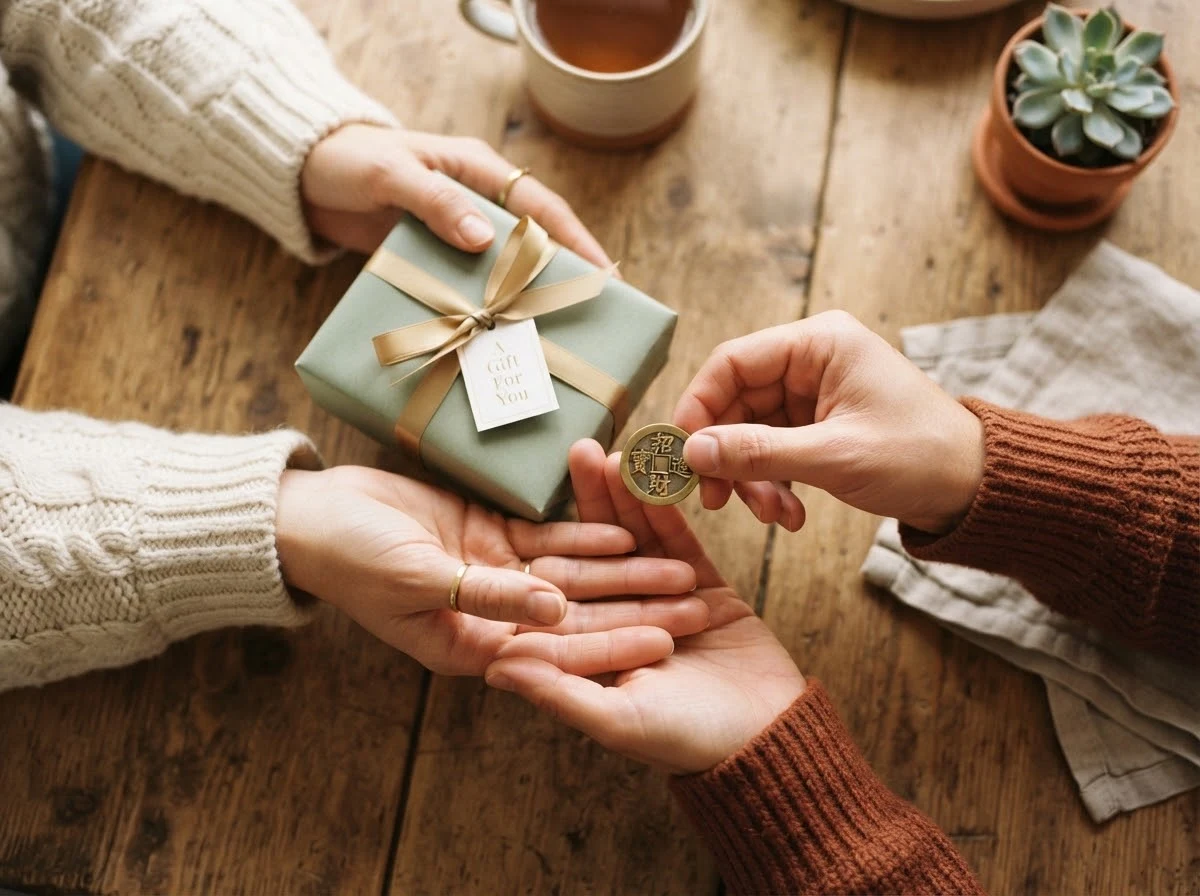
Why gifting gathers so many superstitions
Hand someone a present and you're handing over more than whatever sits in the box. You're saying something about how you see them, what you wish for them, and where the two of you stand. That's precisely why gifting has collected so many superstitions over the centuries. When an object is supposed to carry goodwill, people start to worry about what else it might carry by accident.
Most of these beliefs follow a handful of patterns. Some come down to function: a blade cuts, so a blade might cut a friendship. Some come down to sound, especially in languages where the name of a perfectly nice gift happens to echo a word for death or separation. Others are about timing, colour or quantity, and a surprising number trace back to funeral customs that most people have forgotten, even though the rule they produced is still very much alive.
You don't need to believe a word of it for this to be useful. Knowing that a clock carries real weight for many Chinese families, or that a bouquet of yellow roses reads very differently in Moscow than it does at a North American florist, is simply part of giving well. Here are the superstitions you're most likely to bump into, where they seem to have come from, and what people traditionally do to work around them.
Knives, scissors and the fear of cutting ties
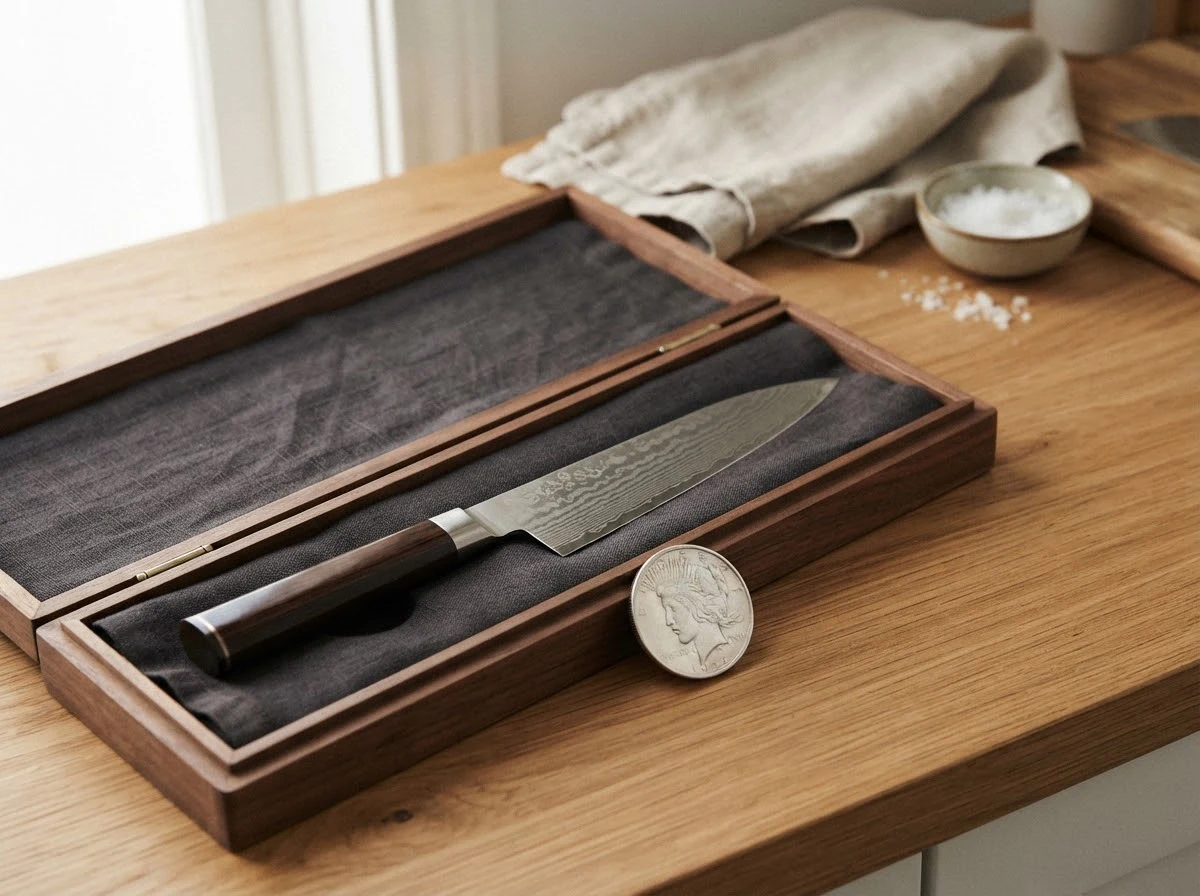
This is probably the most widely known gifting superstition in the Western world, and it turns up across Asia too. The idea is that anything sharp, whether a chef's knife, a pocketknife or a good pair of sewing scissors, will sever the relationship between giver and receiver. It's a textbook case of what folklorists call sympathetic magic: the belief that an object's nature can rub off on the people connected to it. Nobody can point to a single place or date where it started, which is typical of beliefs this old and this widespread.
The trouble is that knives make genuinely excellent gifts. A quality knife set is a registry staple, and a handsome folding knife is a classic present for someone who spends weekends outdoors. So people found a loophole. The recipient hands the giver a small coin in return, which technically turns the gift into a sale. No gift, no severed bond. Many givers now tape a coin to the box or tuck one into the card so the recipient can hand it straight back. In Canada, where the penny was retired in 2013, a nickel or a dime does the job just as well.
One more thing worth knowing: if a knife set is sitting on someone's wedding registry or wishlist, they've already decided the superstition doesn't bother them. Add the coin anyway. It's a small, charming gesture, and it shows you know the tradition.
Never give an empty wallet
A wallet or purse is a lovely, practical gift, but handing one over empty is considered bad form in a long list of cultures. The logic is easy to follow. An empty wallet suggests an empty future, and nobody wants to give a friend a year of thin finances along with their new leather billfold.
The fix is just as simple: put some money inside. A single coin is the minimum, though plenty of people prefer a bill so the gesture feels deliberate. Some families have opinions about the amount, favouring a number considered lucky in their tradition. Either way, the effect is rather sweet. A purely practical present becomes a small wish for prosperity, and the recipient gets to carry that wish around every day.
When a gift sounds like bad news: Chinese gifting superstitions
Mandarin and Cantonese are full of homophones, words that sound alike but mean very different things. Over generations, that wordplay shaped a strong set of gifting customs, and many Chinese families still take them seriously, particularly older relatives.
The clock is the big one. In Mandarin, "giving a clock" (sòng zhōng) sounds the same as a phrase for attending to someone at the end of their life and carrying out their funeral rites. Wrapping up a mantel clock for a Chinese grandparent's birthday can land about as well as gifting a coffin catalogue. Wristwatches sit in a greyer zone; some families shrug them off and others avoid them entirely, so it's worth knowing your recipient before you buy one.
A few other everyday items carry similar baggage. The word for umbrella (sǎn) sounds like the word for breaking apart or scattering, which makes it an awkward gift for a couple or a close friend. Pears (lí) echo the word for leaving or separating, so a fruit basket is better built around oranges and tangerines, which are associated with luck and gold. Shoes are a mixed case, since the word (xié) shares its sound with the word for evil, and the image of someone walking away from you doesn't help. And a green hat, harmless almost anywhere else, is a famous no for a man, because "wearing a green hat" is slang for having an unfaithful partner.
Numbers matter too. Four (sì) sounds close to the word for death (sǐ), so sets of four are avoided, while eight (bā) is prized for sounding like the word for prosperity. Colour follows a similar logic: red and gold signal celebration, while plain white or black wrapping is linked to mourning. As with knives, the token-payment trick sometimes comes to the rescue. If someone truly wants a clock, a coin handed back makes it a purchase rather than a gift.
Japan and Korea: combs, sets and red ink
Japanese shares the worry about the number four, because one reading of it (shi) is also the word for death. Nine gets a similar side-eye, since one way of saying it (ku) sounds like the word for suffering. That's why you'll rarely see a Japanese gift set of four plates or nine cups. Combs fall foul of both at once: the word kushi can be heard as ku plus shi, suffering and death in a single hair accessory.
There's also a gentle, very specific rule for hospital visits. Bringing a potted plant to someone who is ill is traditionally discouraged, because the plant's roots suggest the patient will "take root" in their hospital bed. Cut flowers are the usual choice instead, though white chrysanthemums are kept for funerals.
In Korea, four is unlucky as well, to the point that many buildings label the fourth floor with an F rather than a number. A quieter custom concerns the card itself. Writing a living person's name in red ink has traditionally been associated with recording the names of the dead, so it's best to sign birthday cards in blue or black. Some Koreans also hold that giving shoes to a romantic partner means they'll eventually walk away, which is a slightly heartbreaking thing to learn after buying sneakers for a sweetheart.

Flowers: the count and the colour both matter
Flowers seem like the safest gift there is, which is exactly what makes their superstitions so easy to trip over. Most of the rules come from one source: the flowers a culture brings to funerals and graves become, by extension, the flowers you shouldn't bring to the living.
In Russia, Ukraine and much of Eastern Europe, the count is everything. Even-numbered bouquets are reserved for funerals and cemetery visits, so a bunch of flowers for a birthday or a dinner host should always come in an odd number. A dozen roses, the default romantic gesture in North America, can quietly read as a sympathy bouquet. Some florists say the rule relaxes for very large arrangements, but if you're unsure, add or remove a stem. Color carries meaning there too, and yellow flowers have long been linked with separation or infidelity. They're bright and cheerful to Western eyes, but they're a risky pick for a Russian partner.
Chrysanthemums are the classic example of one flower meaning opposite things. In France, Belgium, Italy and Spain they're closely tied to graves, especially around All Saints' Day on November 1, when families place them at cemeteries. In Canada and the United States, the same flower is a sunny fall porch decoration. In Japan, the chrysanthemum is an emblem of the imperial family, though white ones still belong to funerals. Across much of East Asia, white flowers in general lean toward mourning, and in Mexico, yellow marigolds are deeply associated with Día de Muertos and honoring the dead.
If you're sending flowers across borders, the simplest move is to tell the florist the occasion and the recipient's background. Local florists know these rules cold, and they'd much rather steer you than watch a bouquet go wrong.
Handkerchiefs, pearls and opals: gifts said to bring tears
A handkerchief is about as gentle a present as you can imagine, yet in several cultures, including parts of Italy, Latin America and China, it's often said to bring tears or signal a farewell. The connection is literal. A handkerchief exists to dry your eyes, so giving one seems to invite a reason to cry. If you love the idea of a beautiful embroidered hanky, some people pair it with a coin, the same workaround used for knives.
Pearls carry a similar reputation in Western folklore. Because of their shape and shine, they've long been compared to teardrops, and an old belief holds that pearls given to a bride, or worn on her wedding day, foretell tears in the marriage. Plenty of brides wear their grandmother's pearls without a second thought, but it's useful to know why an older relative might raise an eyebrow.
Opals have perhaps the oddest story of all. Their unlucky reputation is often traced to Sir Walter Scott's 1829 novel Anne of Geierstein, in which an opal is bound up with a character's mysterious fate. The book was widely read, and the stone's image never fully recovered in some circles. Fittingly for this time of year, opal is also October's birthstone, and the old saying goes that only people born in October can wear one safely. If your recipient has an October birthday, you're in the clear on both counts.
Timing superstitions: too early is worse than too late
Some superstitions have nothing to do with what you give and everything to do with when. The best known is the rule against early birthday wishes, which is held firmly in Germany, Russia and Ukraine. Congratulating someone before the day, or handing over a present a few days ahead because your schedules don't line up, is thought to tempt fate. Germans have a neat solution for this: they celebrate the night before and wait for the clock to strike midnight, a custom called reinfeiern, roughly "partying in." Late wishes are generally forgiven. Early ones can genuinely unsettle people.
The more sensitive timing question involves babies. Many Jewish families, particularly those with Ashkenazi roots, traditionally avoid baby showers, hold off on setting up the nursery, and don't bring gifts into the home until after the baby is born. The custom is tied to caution about the evil eye, known in Hebrew as ayin hara, and to a long history of infant loss that made celebrating in advance feel like tempting fate. Similar caution exists in Russian, Eastern European and some Middle Eastern families, among others. It's a custom rather than a religious requirement, and families vary widely in how strictly they follow it.
If you're not sure where expecting parents stand, just ask them, warmly and without fuss. For families who prefer to wait, a Baby Registry is a thoughtful middle ground: parents can share what they'll need on their own timeline, and guests can choose a gift now and arrange for it to arrive after the baby does. Everyone gets to feel prepared, and nobody feels they've rushed the blessing.
Lucky numbers and gifts of money
Cash gifts come with their own rules, and here's the interesting twist: three major traditions worry about the same thing, whether a sum can be divided, and arrive at completely different answers.
In Chinese tradition, money for weddings and Lunar New Year goes in a red envelope, ideally in crisp new bills. Even amounts are generally preferred, because good things are said to come in pairs, and amounts with an eight in them are especially welcome. Anything involving a four is avoided.
In Japan, wedding money (goshugi) follows the opposite logic. Odd amounts such as 30,000 yen are traditional, because an even sum splits neatly in two and that hints at a couple splitting up. New bills are expected for weddings, while condolence money at funerals is usually given in bills that aren't brand new, since fresh notes might suggest you'd prepared for the death.
In Indian families, cash gifts known as shagun typically end in the number one: 101, 501, 1,001 rupees, and so on, with the same habit carrying over to dollars in the diaspora. That extra one is often explained as a sign of new beginnings and continuity, and it makes the amount impossible to divide evenly. Three cultures, one shared instinct about not letting good fortune split apart, and three different ways to honor it.
Housewarming luck: bread, salt and a brand-new broom
Not every gifting superstition is a warning. Housewarmings come with some of the nicest good-luck traditions around, and they make wonderful additions to a more conventional present.
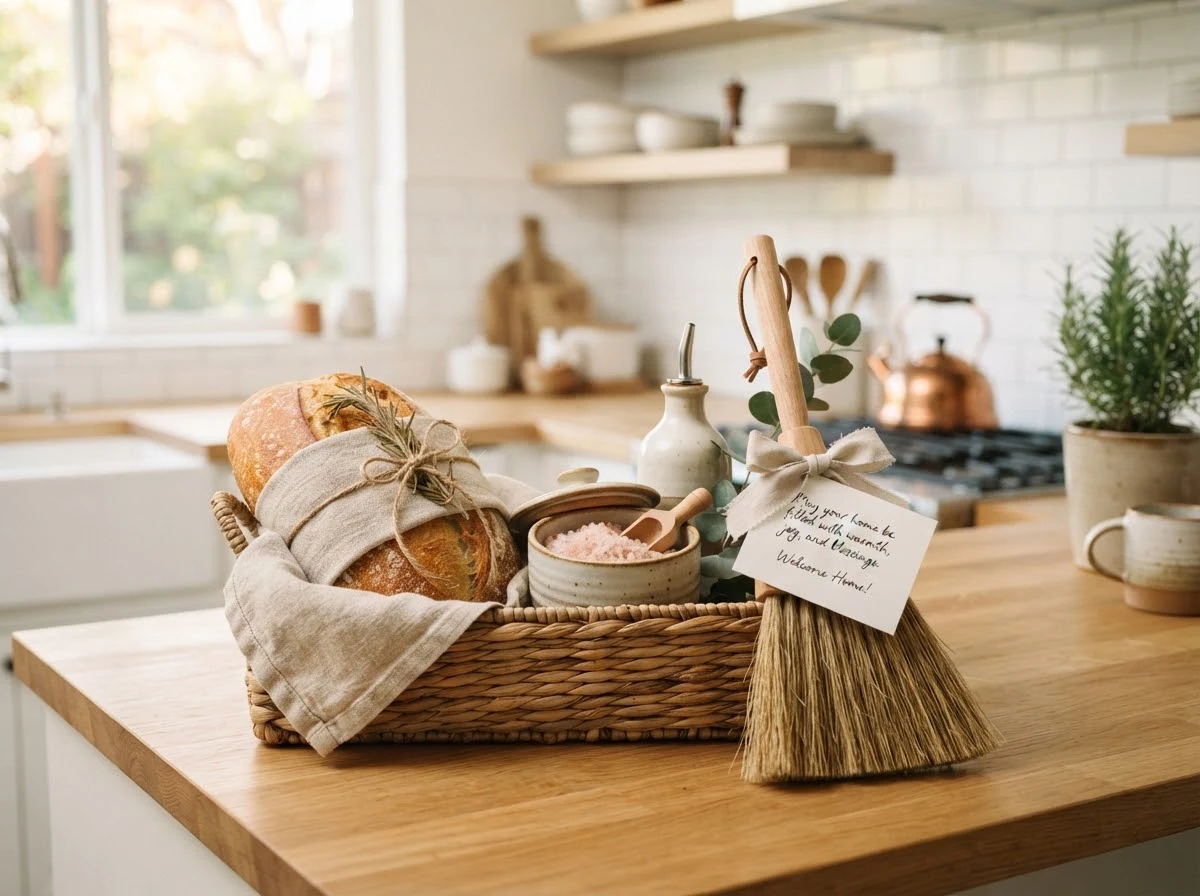
Bread and salt is the best known. In Russian, Ukrainian, Polish and other Slavic cultures, offering bread and salt is a deep-rooted sign of welcome, and many Jewish families bring the same pair to a new home. The wish behind it is lovely: may this household never go hungry, and may life here always have flavor. Some people add a bottle of wine for joy, or honey and sugar for sweetness. North American audiences may recognize the idea from the 1946 film It's a Wonderful Life, in which a family is welcomed to their new house with bread, salt and wine, each paired with a blessing.
Then there's the broom. A long-standing piece of folk wisdom says you shouldn't carry your old broom into a new home, because it will sweep your old troubles in with you. A new broom, by contrast, is a fresh start. A good-quality broom tied with a ribbon is a cheeky, practical and surprisingly meaningful housewarming gift. If the new homeowners have set up a Housewarming Registry, these small traditional touches pair nicely with whatever they've actually asked for.
How to give thoughtfully without overthinking it
None of this is meant to turn every birthday into a minefield. Most people won't notice that you brought eleven tulips instead of twelve, and plenty of families happily ignore every rule above. Superstitions matter most in a few predictable places: gifts for older relatives, gifts that cross cultures, and gifts for big life moments like weddings and babies, when emotions and traditions both run high. If your recipient fits one of those, a little extra care goes a long way.
The workarounds are usually easy and often charming. Tuck a coin in with anything sharp, put money in a wallet, count your stems, and sign the card in blue. When you genuinely don't know where someone stands, asking is never rude. "Does your family do anything before the baby arrives?" is a kind question, not an awkward one.
The harder part is remembering what you learned. You might discover in March that your mother-in-law avoids yellow flowers, then have no recollection of it by her birthday in November. That's the kind of detail Gift Boards are made for. Save it to her private board alongside her interests and the hints she drops, and it'll be waiting for you when the occasion comes around. A shared Wishlist removes the guesswork from the other direction: if someone has added a knife set or a wristwatch themselves, they've told you exactly where they stand. And when you need a new idea that steers clear of the usual pitfalls, the Gift Finder can suggest options by recipient and budget.
The point of all these old customs, really, was always the same thing good gifting is about today. Paying attention to the person. A superstition is just a centuries-old reminder to think about how your gift will feel on the other end.
Frequently asked questions
What gifts are considered bad luck?
The most common are knives and scissors, which are said to cut a relationship, and empty wallets, which suggest an empty future. In Chinese culture, clocks, umbrellas, pears and anything in sets of four are traditionally avoided. Even-numbered bouquets are unlucky in much of Eastern Europe, and chrysanthemums are linked to funerals in several European countries.
Is it bad luck to give a clock as a gift?
In Chinese culture, yes. The phrase for giving a clock sounds like a phrase connected to funeral rites, so clocks are a serious no for many Chinese families, especially older relatives.
How many flowers should be in a bouquet?
In Russia, Ukraine and much of Eastern Europe, give an odd number for happy occasions, since even numbers are for funerals. In North America the count rarely matters, so a dozen roses is perfectly fine.
Is it bad luck to buy baby gifts before the baby is born?
In many Jewish families, and in some Russian, Eastern European and Middle Eastern families, it's traditional to wait until after the birth. If you're unsure, ask the parents, or choose from their registry and have the gift delivered after the baby arrives.
What do you put in a wallet when giving it as a gift?
At least a coin, though many people use a bill. The money symbolizes a wish for prosperity, and some families choose an amount considered lucky in their tradition.